Result, not approved
Voters did not approve the proposed bonds and capital project levy. 16,807 yes (44.54%), 20,925 no (55.46%), all 34 precincts reporting, in unofficial results reported through November 6, 2026 at 9:58 a.m. Central. Minnesota Secretary of State
This guide was written before the vote and is kept as written. City and school district boards canvass local results November 6 to 13. The State Canvassing Board meets November 19.
What the question would add to a property tax bill
Every property in the district would pay more if the question passes. The calculator estimates the first-year change for yours, and the advisor’s table and Nowthen examples follow.
The district's financial advisor estimates that a $400,000 home would pay $419 more in taxes payable 2027 if the question passes. The advisor says the bond tax would stay in place for 26 years, and the capital project levy runs for ten. Farms, rentals, and businesses pay too, because both parts of the question are taxes on net tax capacity.Ehlers calculator That estimate covers the first year only. By this guide’s calculation the bond share raises about $8.4 million in taxes payable 2027. Repaying the full $350 million over 26 years at 4% to 5% interest would take about $22 million to $24 million a year, which shows the size of the debt but is not the district’s schedule. The district says new payments will fill the room left as old debt is paid off. If so, a yes vote keeps school debt taxes from falling as they would after a no vote, and that difference grows even if bills do not rise.
Key facts
- In the advisor’s table for Elk River Area Schools (ISD 728) in Minnesota, a $300,000 home pays $302 more in taxes payable 2027 and a $600,000 home pays $672 more. (Ehlers tax impact table, June 6, 2026)
- A $1,000,000 commercial or industrial property would pay $2,071 more in 2027 in the advisor’s table, less in Anoka and Hennepin counties because of fiscal disparities. (Ehlers tax impact table, June 6, 2026)
- The two parts together are a tax of 10.759% of net tax capacity in the first year, 5.579% of it the capital project levy. (Ehlers calculator)
- The state pays 70% of the bond portion on farmland through the agricultural credit, and nothing toward the capital project levy. (Minn. Stat. § 273.1387)
What would it cost my property in the first year?
The advisor’s table runs from $184 a year for a $200,000 home to $1,210 for a $1,000,000 home in taxes payable 2027. The calculator below estimates any property.
Your property
Use the 2026 estimated market value on your spring 2026 valuation notice. Taxes payable 2027 are based on it.
School taxes you pay now
- Elk River school taxes a yearAt this year's school tax rates, on the value above. Compare line 10, A plus B, on your tax statement from the Anoka County property records search.
- $1,973
Estimated change if the question passes
- School building bondsCalculated split of the advisor's combined rate
- $202
- Capital project levyBallot rate, 5.579% of net tax capacity
- $217
- Total, taxes payable 2027
- $419
- A month
- $35
That is about 21% more than the $1,973 in school taxes you pay now, for $2,392 in the first year.
The total matches the advisor’s published examples. The split between the bond line and the levy line is this site’s calculation, because the advisor published only the combined rate.
First-year estimate (taxes payable 2027). Later bond payments are expected to be larger. The district has not published how the bond portion changes in later years.
Scenario, not forecast. Lines may not add exactly because each is rounded to the dollar.
Assumptions
- The combined rate is 10.7591% of net tax capacity, the figure in the district advisor's calculator.
- The split is calculated. The capital project levy is the ballot's 5.579%, and the bonds are the remaining 5.180%. The advisor did not publish a split.
- The agricultural credit is 70% of the bond portion on farmland and rural vacant land, and none on the house, garage, and one acre. The capital project levy gets no credit.
- School taxes now use ISD 728's taxes payable 2026 rates, 24.502% of net tax capacity plus 0.25477% of market value for the voter-approved operating levy, the same on the Anoka and Sherburne county rate sheets. Next year's rates will differ.
- The estimate is before the homestead credit refund, which can lower a homeowner's net cost depending on income. It assumes no debt service equalization aid, which the district did not receive for taxes payable 2026.
How this was calculated
- Market value becomes net tax capacity under Minn. Stat. § 273.13. Homesteads first subtract the homestead exclusion (40% of value up to $95,000, then $38,000 minus 9% of value over $95,000, gone at $517,200). Homes are taxed at 1% of the first $500,000 and 1.25% above. Rentals with two or more units are 1.25%. Commercial is 1.5% of the first $150,000 and 2% above. Homestead farmland is 0.5% and other farmland 1%.
- Net tax capacity here is $3,894.50.
- Bonds are $3,894.50 × 5.1801% = $201.74.
- The capital project levy is $3,894.50 × 5.579% = $217.27.
- At the advisor's published values, this method reproduces all 20 rows of its June 6, 2026 table to the dollar.
What did the district’s advisor publish?
A table of 20 example properties dated June 6, 2026. The calculator above reproduces every row to the dollar.
| Property type | Estimated market value | Annual | Monthly | Calculator above |
|---|---|---|---|---|
| Residential homestead | $200,000 | $184 | $15 | $184 |
| Residential homestead | $300,000 | $302 | $25 | $302 |
| Residential homestead | $350,000 | $360 | $30 | $360 |
| Residential homestead | $400,000 | $419 | $35 | $419 |
| Residential homestead | $450,000 | $478 | $40 | $478 |
| Residential homestead | $500,000 | $536 | $45 | $536 |
| Residential homestead | $550,000 | $605 | $50 | $605 |
| Residential homestead | $600,000 | $672 | $56 | $672 |
| Residential homestead | $700,000 | $807 | $67 | $807 |
| Residential homestead | $800,000 | $941 | $78 | $941 |
| Residential homestead | $1,000,000 | $1,210 | $101 | $1,210 |
| Residential non-homestead multi-unit and apartments | $500,000 | $672 | $56 | $672 |
| Residential non-homestead multi-unit and apartments | $1,000,000 | $1,345 | $112 | $1,345 |
| Residential non-homestead multi-unit and apartments | $2,000,000 | $2,690 | $224 | $2,690 |
| Residential non-homestead multi-unit and apartments | $3,000,000 | $4,035 | $336 | $4,035 |
| Residential non-homestead multi-unit and apartments | $5,000,000 | $6,724 | $560 | $6,724 |
| Commercial and industrial | $500,000 | $995 | $83 | $995 |
| Commercial and industrial | $1,000,000 | $2,071 | $173 | $2,071 |
| Commercial and industrial | $2,000,000 | $4,223 | $352 | $4,223 |
| Commercial and industrial | $5,000,000 | $10,678 | $890 | $10,678 |
Estimated first-year change in taxes payable 2027, as published by Ehlers. The last column is this site's calculation. Ehlers says commercial and industrial figures would be lower in Anoka and Hennepin counties because of the Fiscal Disparities program.Ehlers
Ehlers' figures include “principal and interest payments on the new bonds, other capital and debt service levies, and capital project levies only.” They are gross increases before the homestead credit refund, which some homeowners receive based on income. The table has no farm rows, although the district's financing page says the advisor's report covers “a homeowner, farmstead or business property.”EhlersISD 728
What would it cost in Nowthen?
About $565 a year for the median homestead in Nowthen’s ISD 728 area, valued at $520,300.
That median comes from the 513 single-unit residential homesteads in Nowthen's ISD 728 area on the county's 2026 tax roll. The middle half of them are valued between $436,000 and $594,300, which works out to about $461 to $665 a year. The Nowthen average home value used elsewhere on this site, $480,372, comes to about $513.Anoka County GIS
These use the same method as the advisor's table. Taxes payable 2027 will be based on the 2026 assessment, so each owner's own valuation notice is a better input than these roll values.
Farm examples
Of Nowthen's 878 ISD 728 parcels, 197 are agricultural. For farmland, the state pays 70% of the bond portion through the school building bond agricultural credit. The capital project levy portion gets no credit.Anoka County GISMinnesota Revisor of Statutes
| Example | Owner pays a year, estimate | State credit, estimate | Without the credit |
|---|---|---|---|
| Farm homestead, house $400,000, land $600,000 | $633 | $109 | $742 |
| Farm homestead, house $400,000, land $1,500,000 | $954 | $272 | $1,226 |
| Farmland not homesteaded, $600,000 | $428 | $218 | $646 |
| Farmland not homesteaded, $1,500,000 | $1,070 | $544 | $1,614 |
This site's estimate of the first-year change, taxes payable 2027. Neither the district nor its advisor published farm figures or the schedule that says how much of the combined rate is credit-eligible bond tax. These rows assume the whole remainder after the ballot's levy rate is new bond tax that qualifies for the credit, so the credit could be smaller. Homestead land is assumed to be below the first-tier limit of $3,840,000, taxed at 0.5%.Minnesota Revisor of StatutesMinnesota Revisor of StatutesMinnesota Department of Revenue
What does the first-year figure leave out?
It leaves out later years. The published estimates cover taxes payable 2027 only, and later bond payments are expected to be larger.
The capital project levy is a fixed rate, so the dollars it raises change with the tax base over its ten years.Minnesota Revisor of Statutes
For the bonds, the district says new debt is “timed to fill the slots of older, retiring debt.” An Ehlers chart from June 2026 shows the district's existing debt and capital tax rates stepping down from taxes payable 2026 through 2040 as old bonds are paid off.ISD 728Ehlers for ISD 728
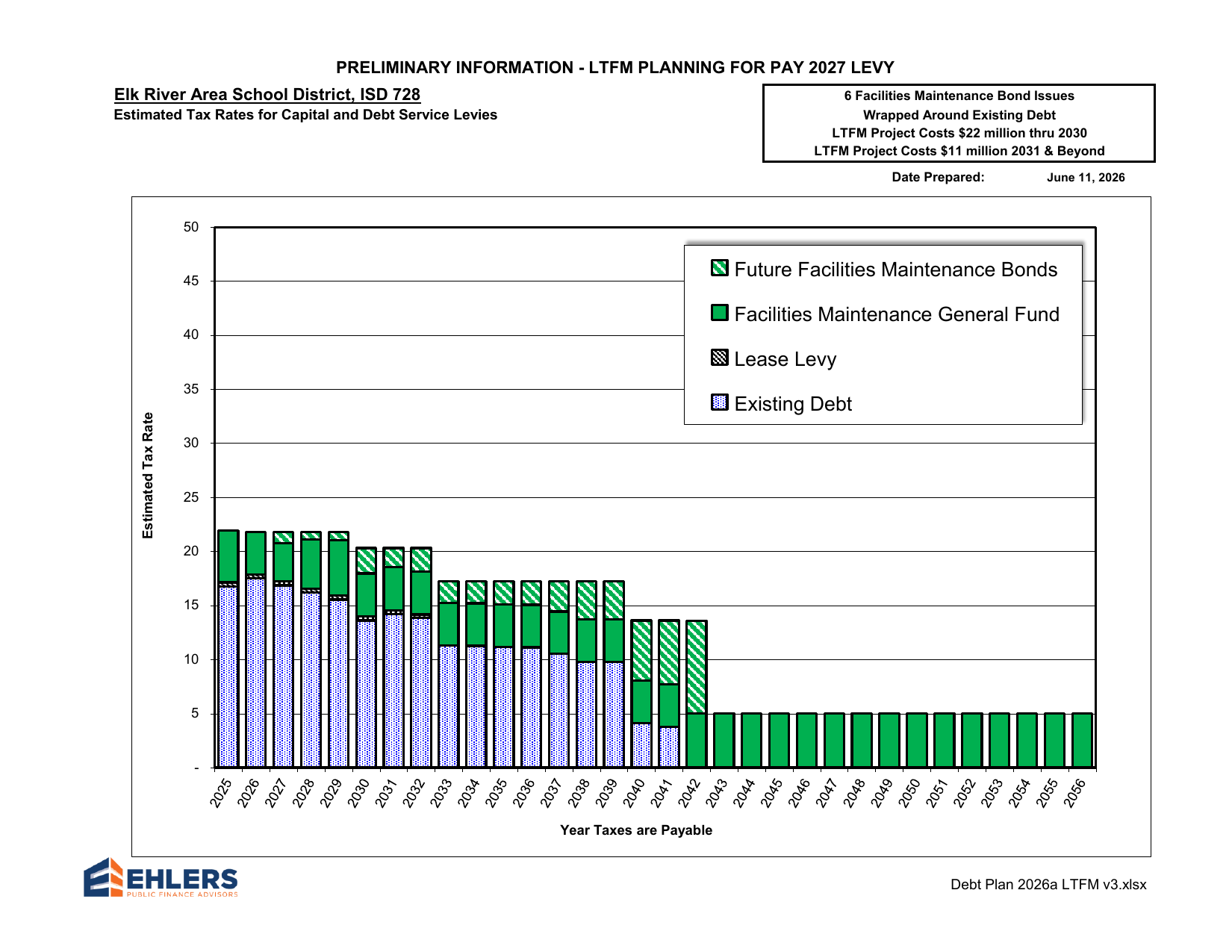
To translate those rates into dollars, each point of tax rate costs about $39 a year on a $400,000 home and about $53 on the median Nowthen home in the district ($520,300), at today's values. A drop of several points as old debt retires is several times those amounts each year.
If the new bonds fill those slots, a property's school debt tax under a yes vote would stay closer to today's level, while under a no vote it would fall as old debt retires. The difference between the two outcomes would then grow in later years. That reading is an inference. The full debt plan for the proposed bonds, with rates by year, would confirm or correct it, and it has not been published.
The yearly payment figures in this guide assume interest of 4% to 5%, which is this guide's assumption and not a published rate. The district says Moody's raised its rating to Aa1 in 2024, and a lower rate would mean a smaller payment. At 3.5% the full $350 million would take about $21 million a year, compared with about $22 million at 4%.ISD 728
The district's long-term debt outstanding was $280,715,000 on June 30, 2025, the most recent figure it has reported. An older schedule shows when that kind of debt is paid off. Ehlers' January 2024 preliminary official statement for the refunding bonds lists $262.81 million in principal and $67.04 million in interest on the district's general obligation debt as of February 28, 2024, counting the refunding bonds at their preliminary size, with the last payment in fiscal year 2040. The district says it timed the referendum to line up with a drop in those payments.ISD 728Ehlers for ISD 728ISD 728
For context, Nowthen's ISD 728 taxing area pays a school net tax capacity rate of 24.502% for taxes payable 2026, of which 10.175% is voter-approved. It also pays a school market value rate of 0.254770%. The county lists 0.168380% of that as voter-approved, which includes the 2019 operating referendum, and 0.086390% as other.Anoka County
Sources for the method
- The combined rate of 10.7590899674104% of net tax capacity is read from the advisor's calculator.Ehlers calculator
- The ballot sets the capital project levy at 5.579% of net tax capacity.Resolution
- Class rates and the homestead exclusion are those in Minn. Stat. § 273.13 as published by the Revisor, which the advisor's calculator also follows.Minn. Stat. § 273.13
- The agricultural credit is 70% of eligible net tax capacity times the school debt tax rate, which is the debt service levy divided by net tax capacity.Minn. Stat. § 273.1387Minn. Stat. § 275.08